
The Ghost of East Germany
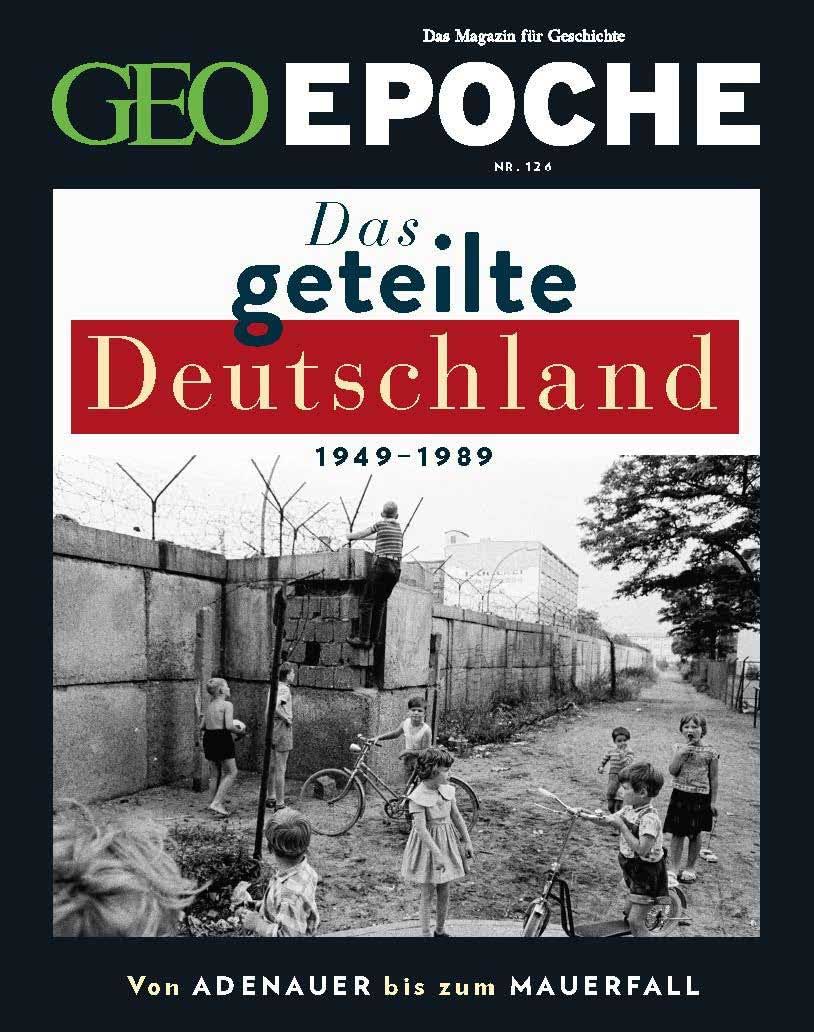
The German historical magazine GEO: Epoche has published an issue about Germany after World War II, titled "Das geteilte Deutschland," in English "The Divided Germany." It makes curiously pertinent reading today, in the context of the present-day dis-United States and the bunker mentality that afflicts the warring sides. Neither side wants to compromise any longer. At this point, only the skill and self-interest of our political leaders fends off deeper conflict, which would adversely affect them, of course!
At the end of the War, the victorious Allied Powers, Britain, America, and Russia held a conference in Potsdam, Germany, and reviewed plans for the Post-War Germany. They decided to divide it into "Zones" to prevent it from making war again. Thanks to the Soviets' dictatorial machinations, their "Zone" evolved into a separate Marxist nation "Die deutsche demokratische Republik," often called by its initials "Die DDR."
The East German administration, with a Marxist agenda and supported by the Soviet Army, more or guaranteed East Germany would land dead in the water. In haste, it confiscated all private property, called "Privat-eigentum" in German, and made it state-property, or "Staatliches-eigentum," before it had enough opportunity to digest what effects confiscation would have. The Soviets controlled the affairs of East Germany in the beginning and, in reality, dished out Marxism as a punitive measure, which it is, anyway!
All of the leadership positions went to risk-averse Party loyalists who seldom made suggestions or objected to Party policy. They mostly raised objections if the measures of the other executives did not implement the full punitive stupidity of Marxist dogma. Present-day Americans should not fool themselves: Marxism is by its nature punitive. "Confiscation" robs a citizen of an independent life, financial success, and basically confiscates his individual personhood. These Marxist deprivations come straight out of his Communist Manifesto.
Not surprisingly, many East Germans wanted to leave right away. Until the Berlin Wall cut them off from the West, they visited West Berlin and could not miss seeing department-store windows full of merchandise. They saw the average citizen's freedom of movement, personal expression, and the civilian character of it all. By the time the Marxist government had erected the Wall, at least three million East Germans had already fled to the West. The GEO Epoche describes their actions as "Abstimmung mit den Füßen," or voting with their feet!

The article "Ein Dorf macht rüber," in English "a village crosses over" recalls a unique instance of East Germans in flight to the West. The tiny village of Böseckendorf lies so close to the former border, the villagers decided to flee, while they had a chance. They knew that the Communist authorities planned to relocate them to another village farther from the border, to keep them from leaving.
They loaded up a horse-drawn wagon with a few personal belongings and waited until night to start their trek across the border. A relative of some of the refugees lived just across the border in West Germany. She awoke with a start at someone rapping on her window. She looked outside and saw a crowd of people. One man spoke from the darkness, "Tante Elisabeth, wir sind hier!"
The crowd stood in the darkness and waited for "Auntie Elisabeth" to let them in—men, women, old people, children, and a family dog. Two babies lay fast-asleep in a laundry-basket. The article says that, including the babies, 53 people had made the dangerous and illegal trek to freedom. They fled not just to personal freedom, but to the "Überlegenheit des Kapitalismus," the promise of capitalist wealth.
You could say that Uncle Bernie Saunders waits in his Democrat-Socialist theoretical utopia for the refugees to return. Why bother? Many East Germans who did not flee to the West wished afterward that they had left. As time went on, the Marxist utopia could no longer carry weight as a functioning reality.
Maybe modern-day Americans need a reality-check to deal with a Marxist candidate who has the potential to tilt the scales against traditional Western values. They need to remember that the term "Bourgeois" grew out of the medieval culture of walled cities. The Bourgeoisie lived in a "Bourg," where they had the freedom to pursue a profession, earn a living from it, and raise families, safe from thieves and foreigners. Their rulers let them plant orchards, work foundries, textiles, wood, or wool. They used currency minted from precious metals, so that many nations could use it without having to go through money-changers, to enhance trade.
In other words, the walled-city concept works! As the walled cities grew wealthier, more and more people wanted to live there. Nothing has changed the efficacy of it. If the concept works, leave it alone, Uncle Bernie!