
A Problem with Truth-2

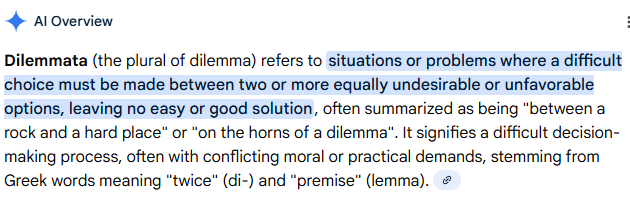
This "Kompromiss" article by Professor Nils Goldschmidt interested me enough that I decided to do as second post on it. For one thing, he posits a compromise-solution to organizational problems so negatively, it is effectively a lose-lose proposition. He uses the German word "Dilemmata", the plural form of the English word "dilemma", to define a confluence of hindrances to the flow of progress. I looked up "Dilemmata" on AI Overview to help me understand it with a fresh eye. The AI Overview definition confirms its negative context.
Professor Goldschmidt also quotes the American philosopher Martin Benjamin who describes a compromise as "splitting the difference"—having to accept losses with a "bitteren Beigeschmack", a bitter aftertaste, and a "Gefühl des Bedauerns" a feeling of regret. You take your bitter medicine like a sinner enduring punishment. The only reason organizations employ a compromise, he says, is "um des lieben Friedens willen", a plaintive request to maintain the peace. He uses this phrase three times in the article, by my count.
My reader may sense, however, that "compromise" often conceals a moral imperative that overrides the normal functioning of something. The amount of space that one side gives up to maintain the peace represents the exent that you go to avoid conflict. You have too much invested in the status quo to risk any push-back. Your opponent, by contast, feels he has nothing to lose by threatening the status quo. The problem arises when a party uses compromise to further the goals of DEI: diversity, equality, and inclusion. You don't pursue the best course of action, but compromise on it, in oder to apease the perpetually pissed-off opposition.
It costs a lot more, because you have to take a pluralistic view of calculating a budget, allowing several, disparate mini-budgets to act as one budget. You finance the agenda of constituencies who have little in common and may effectively work against each other. A compromise under those circumstances may still be okay, as long as you can continue to pay off the warring constituencies.
A legislator or President may conclude he has to support the negatively oriented compromise in order to maintain the status quo, if not the problem-free functioning of the society. He may ask himself, why not divide the country into smaller harmonious constituencies, if they do not agree on anything? Then the shit really hits the fan, when he realizes the truth about "Truth", that truth really means the objective information about the pissed-off opposition, that it does not want a separate status, that it actually subordinates itself to the status quo with all the hostility it can muster. Not only that, but a legislator or President must conceal that the pissed-off opposition understands little about the reasons for its own actions.
But Goldschmidt's support for compromise goes further. He paraphrases the Austrian philosopher Karl Popper who said that "es keine absolute Wahrheit gibt und keine endgültigen Gewissheiten." Does Goldschmidt really believe that? "No absolute truths, no enduring certainties"; so we have to compromise, following this logic, to cover all the hypothetical bases? No wonder everyone feels frustration and resentment that improvements move so slowly in Germany.
Goldschmidt concludes his article accordingly, clearing away any philosophical mumbo-jumbo: "In short, we mistrust the self-serving truth-sayers of the all-powerful man and all-powerful woman," and accept the equal validity of the "Andersartige", people who think along contrary lines. We have to accomodate them, he reveals gradually, as a moral imperative. His actual political sympathies are more-or-less doctrinaire leftist, with academic trappings.
No wonder he relies so much on the workings of a committee. John LeCarré describes a committee in his novel Tinker, Tailor, Soldier, Spy as a "creature with four back legs". In real life, one or two people in a group will dominate the discussion with race-, class-, or sexually-oriented moral imperatives. I sit in German restaurants and cafés and listen to a single persons speak adamantly, as if his audience can't agree with him quickly enough. So much for Goldschmidt's criticism of "self-serving truth-sayers". Humanity has a lot of them. Most of them think like he does: we have to give contrariness equal consideration, as a matter of principle.
To tell them that they could create their own country and escape the poor conditions of this country will only produce outrage.They already have enough problems with existential angst, from feeling like outcasts. Don't make their problems any worse. They don't even want compromise. They want non-negotiable demands; but all that blunted protest also blunts the forward-moving intentionality of the nation.