
More Diversity!
More Diversity!
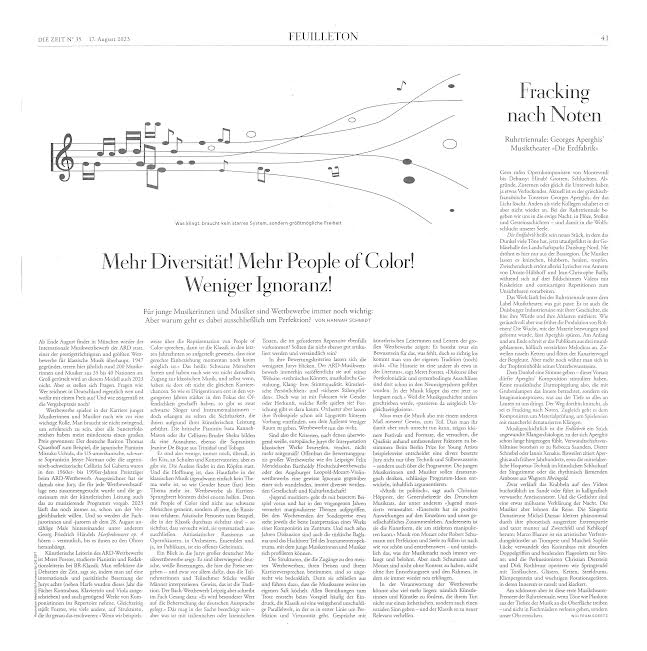
This article appeared in the August 17th issue of Die Zeit newspaper, written by Hannah Schmidt, a free-lance music critic. In English, the title of her article means, "More diversity! More people of color! Less ignorance!" She addresses her concern about racism and discrimination at one of Germany's notable music competitions. At the end of the first paragraph, she asks the question, "Who makes the decisions about how and why a particular performer wins a prize, and does this system keep up with the changing times?"
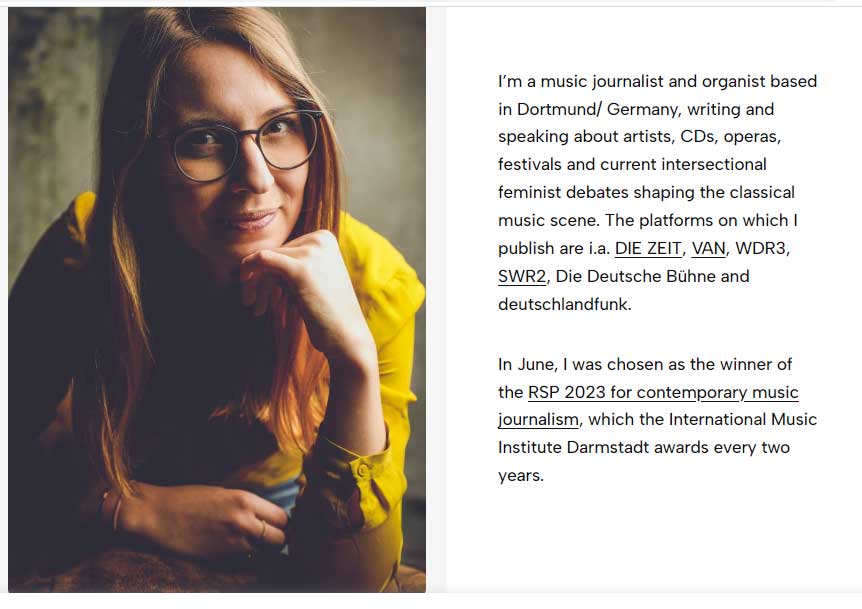
In the third column, she writes, "The judges award prizes for performance qualities like technical brilliance, the quality of the sound, and sensitivity for the intentions of the music." But she then asks, "Why don't the judges factor in the race and gender of the performer." She goes on to say that the "Structure of the competitions and a performer's access to them is as unjust as you can imagine." She adds, "Blacks do not get the same access."
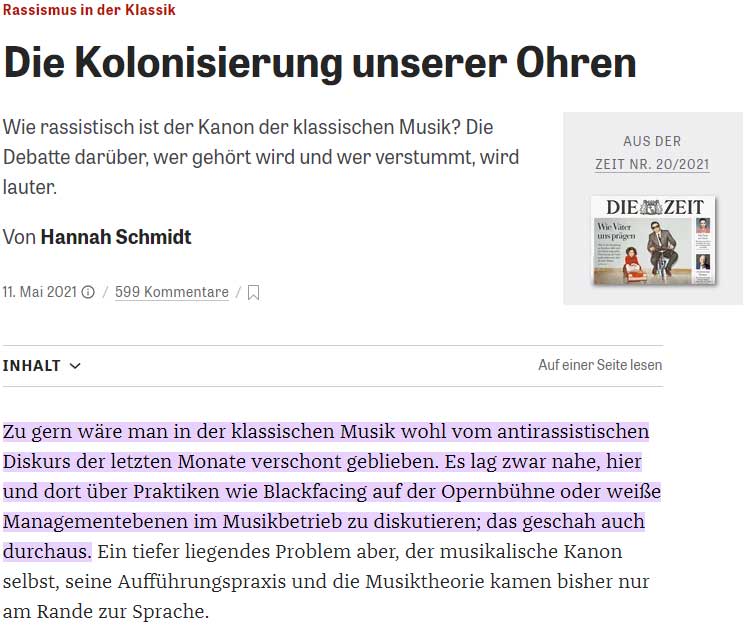
Schmidt really lashes out at the classical music world: "Everyone believes falsely that classical music is this guiltless parallel world, in which perfection and virtuosity reign supreme." This ties in with something Schmidt wrote in Die Zeit back in May of 2021: "The movers and shakers in the classical music world would gladly remain protected from accusations of racism."
Certainly! They want no part of accusations that besmirch organizations they have worked hard to support. It's bad for business. Brow-beaters like Hannah Schmidt understand this weakness about established organizations. Accusations work like heavy-metal poisoning, and every organization with even moderate success has grown accustomed to accusations of racism and discrimination. Schmidt issues her accusations in scattershot-style. Musicians and organizers, being the sensitive, cultured people that they are, will probably cave in to her dictatorial diatribes.
The hectoring, superior tone of Schmidt's writing impressed me, since she is only a music critic, not a music professor or leader of a musical organization. If she wanted to, she could take a more individualized, pro-active stance, and create her own musical niche. She could create her own competition and serve as its first acting-chairwoman. I suspect she lacks the courage and initiative to take such risks, having responsibility for it or taking flak for its mistakes.
So much easier to prey on someone else's hard-working organization. She wants to dictate terms to existing organizations and competitions by browbeating them into submission. Some people need to moralize in order to feel powerful, or just to stay on par with their contemporaries. They climb a power-pedestal and gain leverage over others that they should not have.
I am also troubled that Schmidt writes with a political agenda, not a musical one. She admits it and doesn't even particularly care if the inclusion of minority musicians lowers the performance bar. She doesn't care if audiences don't particularly want to hear the music of unknown composers from Africa or Asia. Force-feed them foreign music for their own good!
Schmidt exudes feminist-grade tyranny, through and through, and masquerades it as tolerance and diversity. I don't know about Germans, but Americans have also had to deal with dictatorial moralizers, browbeating us into submission. This woman just doesn't get it, that a freedom-loving society allows people to live the way they want, even smugly and hypocritically. Such freedoms requires a tolerance that Schmidt is incapable of allowing.
Schmidt does not want the minority performers or composers to feel that they have anything to prove. We should accept them on principle, even if we smile falsely and applaud tepidly. Just getting her way suits her fine. This whole thing is about her power-trip.