
We Need a Plan!
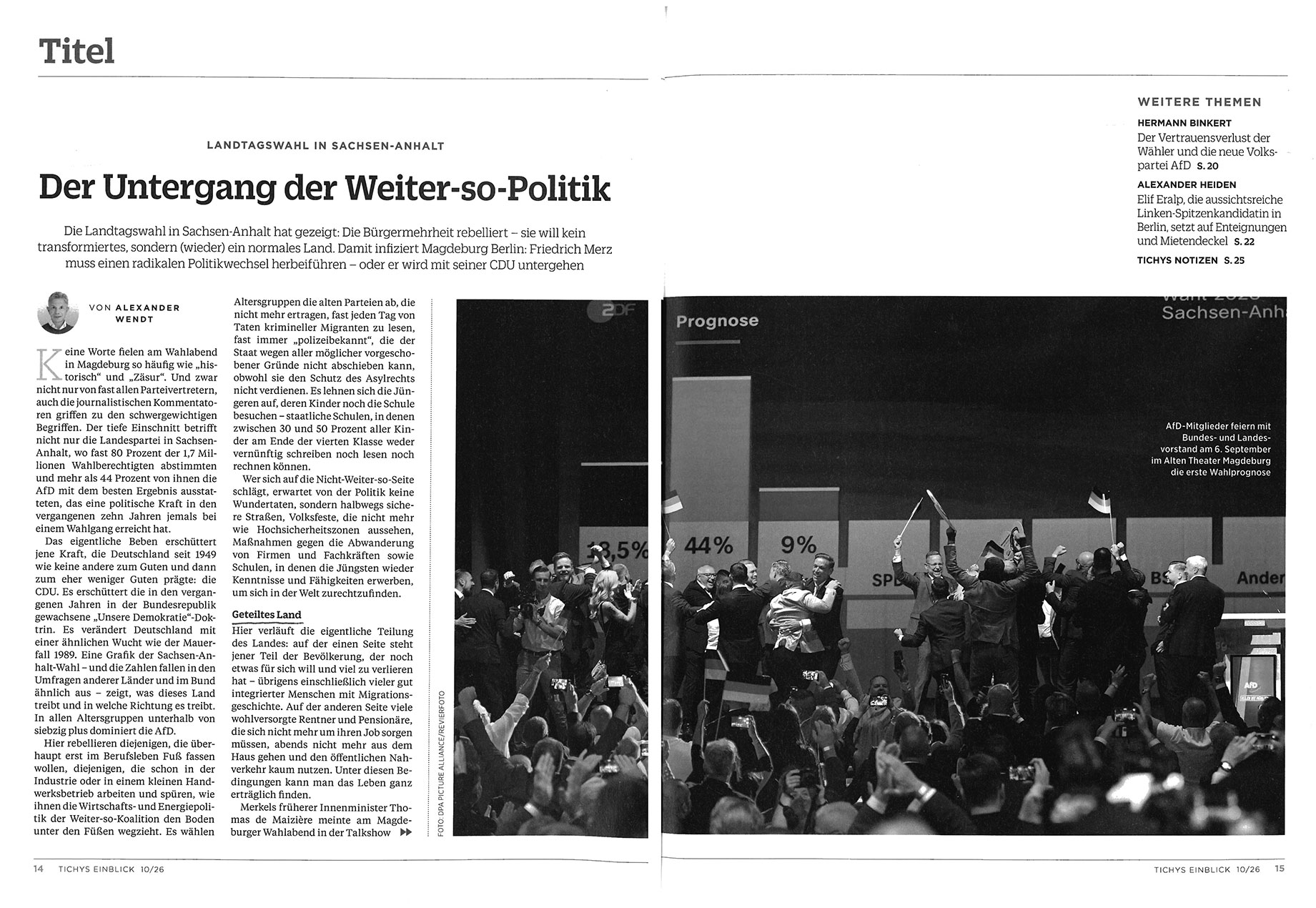
The October issue of Tichys Einblick features an analysis of recent state elections in Germany and the decline of Germany's traditional Conservative party, the Christian Democratic Union (CDU). The title of one article in English "The End of Status-Quo Politics" suggests that one quote from the CDU Chancellor Friedrich Merz explains the public's loss of confidence in his leadership. He said "We need to determine which direction to take the country."
Germans must be asking themselves, who is "We?" Does Merz not yet have a sense of direction or an activated plan to lead the nation, or does he need the public to give him his political coordinates? Shrewd insiders recognized this as a colossal faux-pas. As a result, the people who once voted for him now want to turn him out of office.
The insight that Tichys Einblick conveys is that the voting public elected Merz with the assumption that he already had a fairly complete agenda for governing. Instead, he appears to want a consensus before he undertakes anything, and appears to pass off the responsibility for governing the nation to the voters.
The voters, on the other hand, expect their leaders to hit the ground running, with effectively a carte blanche, whether voters in the U.S, the United Kingdom, or in other democratic country. The public mostly feels helplessness and fear about the challenges facing the country, since it has hardly more than a superficial understanding of them. We call our nation a "Representative Democracy." It isn't, of course. If our leaders did follow the fickle public's direction, the nation would have fallen by the way-side long ago.
Worse than anything, in the voter's eyes, Merz fails to convey a personal engagement as the leader of his country, as the driving force behind its sense of priorities, perhaps because he doesn't want to risk rejection by the voters. The voters don't feel that they can follow Merz's leadership because he doesn't lead. They don't know what he wants, other than re-election.
Not surprisingly, the voters reject him anyway because his equivocal statements reveal him only as a bureaucrat who relies on others to provide his direction and initiative. The public doesn't want the responsibility for making decisions, that requires information and insight beyond its meagre level of understanding. The public wants leadership that exudes confidance and attitude, that takes the helm, and nakes decisions in conjunction with other knowledgable officials. As voters, they can reject it all later!
The public needs to perceive that its leaders step into their leadership position with a plan that acts like a point of light emanating from a distant lighthouse during an existential journey. The public needs this reassurance while it crosses dark seas, led on by projections of growth and solutions to problems. The leader cannot let anyone know how falsely-inflated he feels.
He has to publicize his policy initiatives to give the voting public a sense of his philosophical and logistical orientation. The voters may reject him, but he has to risk this. It's like any courtship in the human realm. More than anything, the courter needs to reveal a sense-of-self and personal strength to the courted. It is the only way to further the courtship.
The point is that politicians aren't necesarily leaders. Merz's quote reveals as much. I'm not singling out Merz for criticism. In fact, he reveals that politicians outnumber real leaders by a factor of five to one. It is risky for a politician to nail his career to the ideological mast of the ship that steers his career through the fickle seas of public opinion.
If the voting public perceives him as trying to validate "antiquated" solutions, or appearing "out of touch with the times," it could set back, or even end his career. A "honest" or "forthright" politician inevitably exacerbates dissent, causing it to coalesce into a pro-active force. His words will sharply delineate his friends and enemies.
The media may choose, on that basis, to represent him as an extremist, for wanting to deviate from coordinates set by previous political leaders. Speaking frankly will fill the ammunition box of his enemies, which they can use to attack him, whether they honestly and responsibly reflect his views or not. If the voting public resents their leaders hold them hostage, they should remember that their leaders resent the fickle public for holding them hostage.