
A Problem with Truth
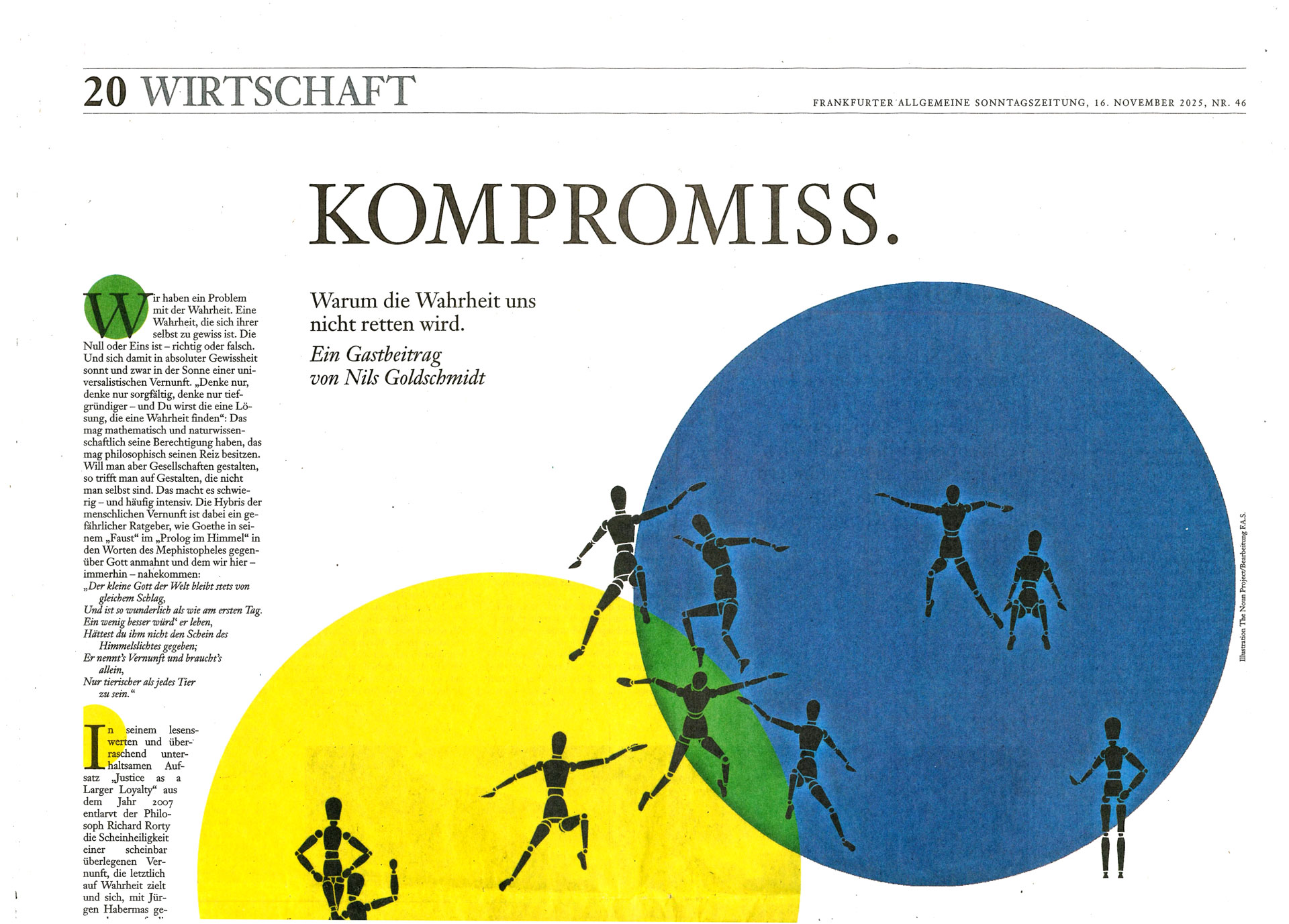
This article "Kompromiss" appeared in the business section of the Sunday Frankfurter Allgemeine newspaper on November 16th. My misgivings with this article start with the author's choice of an under-title: "Warum die Wahrheit uns nicht retten wird." Or in English, "Why the truth won't save us." And I thought, wait a minute. This article was supposed to concern itself with the necessity, philosophy, and artistry of the compromise—giving ground on solution-finding when disagreements in an organization threaten to block forward movement. The author Professor Nils Goldschmidt warns "We have a problem with the truth, when the 'truth' is too sure of itself." You can talk about the opposing sides in a discussion and the incompatible solutions that they propose. Why should that undermine a sense of truth as a constant?
In discounting "Truth" as an important parameter in any discussion, Dr. Goldschmidt seems to suggest discounting external reality itself. He seems to think like anyone who has lived too long in an ivory-tower. "Truth" has blinded him to the truth about problem-solving, that the give-and-take of productive, informed discussion enables many solutions. Information accumulates from multiple sources and involves immutable measurements of things: length and width, height and weight, expense, and time-windows. The calculations must also account for unforseen circumstances, narrowing the risks as much as is practical. It is a fairly fail-safe way of doing business that goes on everyday.
Goldschmidt writes that pride has conditioned us to believe in an "absoluter Gewissheit" (absolute certainties) in the bright sunlight of an "universalistischen Vernunft" (universal truth). He continues that these terms may work in the fields of mathematics or natural sciences, but not so well when building the constitutional framework of a human society: "Hubris makes human reason a risky advisor." Goldschmidt quotes from the German writer Goethe who writes in his revolutionary play Faust that human reason contains "den Schein des Himmelslichtes" (illusion of heavenly light); but nowhere in the article does Goldschmidt talk about more earthly affairs, like running a business, where producers and customers depend on active knowledge about things like inventory, outstanding orders, accounts receivables, and logistics. They need an experienced human judgment, assisted by mathematical certainties. The modern World depends on this unheralded symbiotic relationship.
Then Dr. Goldschmidt quotes from a book by the American economist Richard Rorty, Justice as a Larger loyalty. He praises Rorty's disabusing us of the "Scheinheiligkeit einer scheinbar überlegenen Vernunft" (the false sanctity of a prevailing system of reason). "Justice" stands above the parameters of "Truth"? Don't try to judge people when they make irresponsible choices or fail to keep their account-books up-to-date?
In the back of my mind, I keep wondering, who is this guy really criticizing? People who trust too much in their reasoning faculties? Single-minded people who can't entertain opposing viewpoints? So, the German radical party the AfD, the Trump administration, or constitutional originalists? The format of this "Kompromiss" article has all the tendentiousness of a political attack, couched in softer academic terms.
I also picture Professor Goldschmidt hard at work in his ivory tower, working through the night to finish up another essay, another book or speech, like so many scholars. Outside, the local Uber Eats crew waits to serve him his nocturnal coffee and croissants, so that he does not have to stop. If he can allow himself to stand back from his concern with human reason and Hubris, he might detect in the functions of Uber Eats the very "reason" he cannot see in philosophy, his own included.