
Anne Rabe Retreats to the Familiar
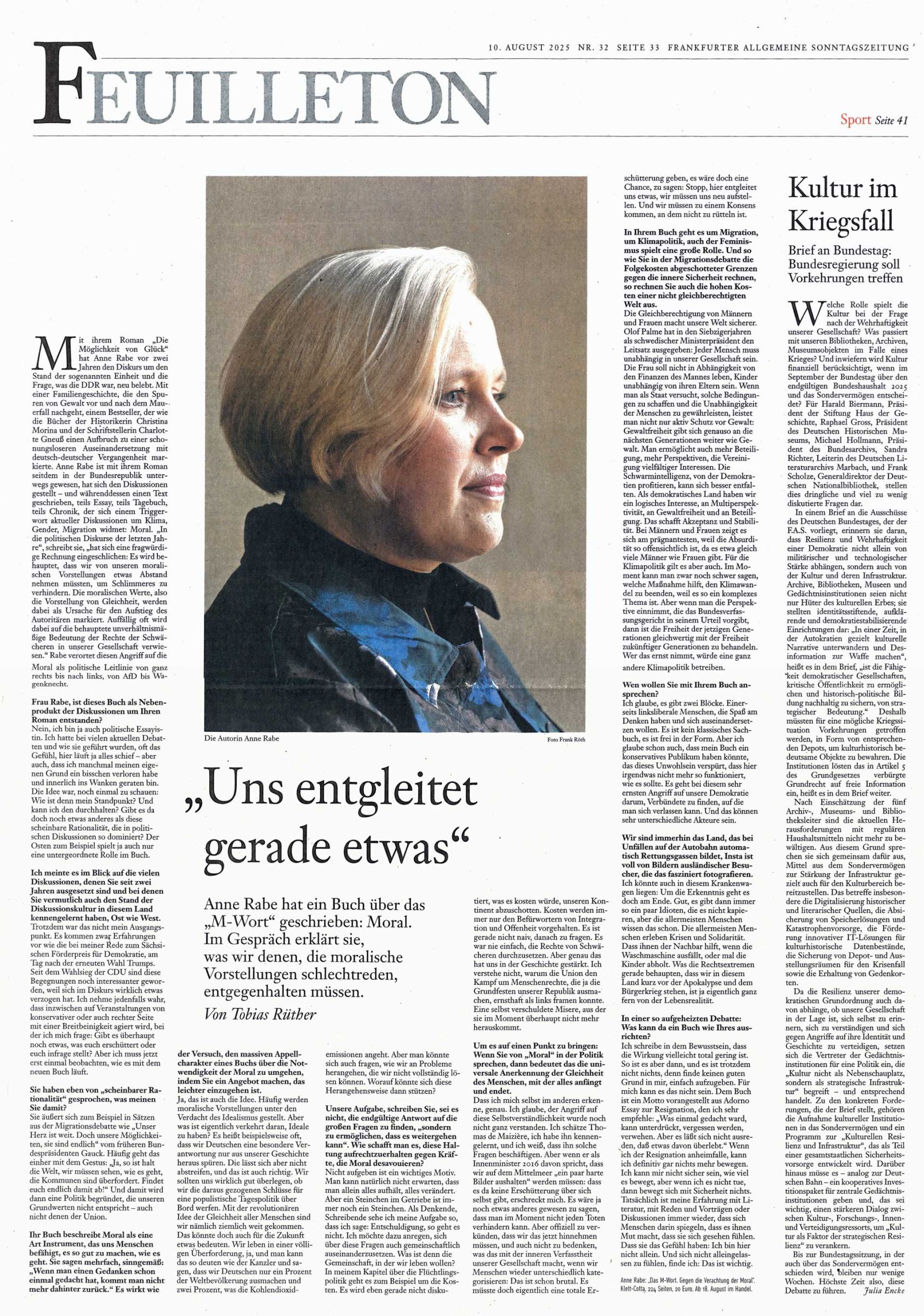
This article, "Uns entgleitet gerade etwas", translated into English, "We have let something slip away." appeared in the Sunday edition of the Frankfurter Allgemeine newspaper on August 10th, during my visit in Germany. A staff-writer for the Frankfurter Allgemeine conducted an interview with the novelist Anne Rabe that spans nearly an entire page, perhaps 2,000 words.
The "something" that has slipped past, she explains, is morality. Rabe has published a book about it titled Das M— Wort, gegen die Verachtung der Moral. In English, "Using the 'M' Word to Restore Morality in Politics". Using the moral high-ground, she trots out each predictable left-wing talking-point, introducing each point over the course of the interview: equality, feminism, the rights of the poor, exploiting the wealth of others, and communicating a fear of right-wing extremists.
Like every other left-wing spokesperson, she leaves her actual intentions in the shadows, if not in the dark, inasmuch as she says hardly anything about specific steps that she would take to promote morality in politics or to enact pro-active policies. She does not mention wealth-creation once, as if wealth magically reproduces itself. Mostly, Rabe talks about how "Kapitalismus untergräbt unsere Fähigkeit zur Moral." In English, "Capitalism undermines the morality of our society."
Rabe makes of point of never mentioning her own party affiliation, but only Die Linke party, the resurrected Communist Party of East Germany, talks in those terms. I find that interesting since she was born in 1986 in East Germany, during its final years. How could Rabe revert to a government system that many people risked their lives to escape, that shot fugitives mercilessly? Maybe, in the end, individual freedom is not so great. "Community" is better.
Her parents and their friends must have participated in the street-demonstrations that brought East Germany to an end. They would have fled through the breached Berlin Wall, rejoicing over their new-found freedom and free beer in West Berlin, and remembered it long after as a defining event in their lives. Then, after a few years in the "United" Germany and its personal-freedom, risk-taker ethos, they must have longed for a return to the controlled-community concept that East Germany represented to them. Their self-esteem must have taken a hit when they retreated to it.
I saved the page from the newspaper and have been sitting on it ever since, too busy with my own novel to bother with it; but since my return to Germany, earlier this month, the topicality of it just goaded me to write something on it, while the huge rifts in the culture, following the assassination of Charlie Kirk, continue to resonate in the media.