
Heuss and Scheel
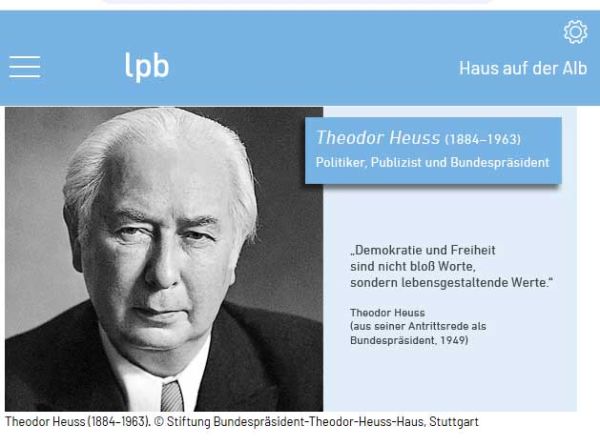
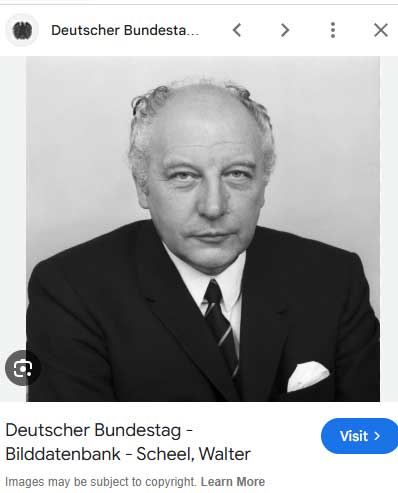
Theodor Heuss and Walter Scheel had the challenge of re-establishing a constitutional republic in Germany after the horrors of World War II—converting the end-game oriented Nazi administration to a civilized government with civil rights and individual freedoms, that allowed private spaces and an active civilian economy, proved a challenge. The Soviet Union angled for influence in Post-war Germany, sabotaging Allied efforts, and frankly exerting dictatorial control.
Millions of innocent Russians, Poles, and Jews had lost their lives to the fantastically cruel Nazi war-machine. The victorious Allies demanded justice for the victims, and so created the Nazi war-crimes trials. In Nuremberg, they put on trial every surviving leader of the Nazi regime whom they could locate. Of the approximately 24 defendants at Nuremberg, 13 received the death penalty, of which two escaped by committing suicide in their prison cells.
The American prison in Landsberg am Lech housed mostly SS personnel and Einsatzgruppen, who conducted mass executions behind active army units. The Americans executed about 250 of their prisoners by hanging, another 29 by firing-squad. The British prison at Hameln, on the other hand, housed mostly concentration-camp personnel. After quick trials, the British executed about 200 of them. Similar trials took place behind the Iron Curtain, in Krakow, Poland, and Riga, Latvia. The French, Dutch, and Norwegians also held trials, mostly for native Nazi-collaborators.
Then again, these numbers don't include the unofficial acts of street-justice carried out by front-line Allied soldiers who liberated the concentration-camps. The vengeful camp-inmates turned on their former captors and literally beat them to death, as Allied soldiers looked on and did nothing to stop them.
The Soviet Union, having lost so many young soldiers to Nazi atrocities, force-marched German prisoners-of-war to collective farms, where they spent the next five years harvesting crops. In East Germany, Soviet police forced-marched former members of the Hitler Youth to Russia to un-learn their Nazi orientation. In East Germany, the first justice minister Hilde Benjamin, whose husband Georg had died in a camp, took her own revenge against former Party members, putting as many of them in prison as she could.
So Heuss and Scheel had quite a challenge, to repair Germany's reputation and to move Germany forward, in the face of so much rage over the loss of life and the destruction of physical property. Fortunately for everyone, the two men represented the FDP party, the Free Democrats, Germany's bourgeois party. Fate could not have chosen better situation for them. They looked after the nation's shops and factories, to insure the nation could pay its bills, innovate its infrastructure and repair its relations with the many war-victims—saying "I'm sorry!" in so many words.
Now, 80 years after the end of World War II, the German government needs lift the burden of guilt from the German people once and for all. Their guilt-orientation does nothing for them, if they want to inhabit and define the nation in which they live. Or do they only want to live out their lives in a convent, to fruitlessly redeem themselves in the eyes of a World that only wants to exploit them?