
Why Men Have so Few Friends
Why Men Have so Few Friends
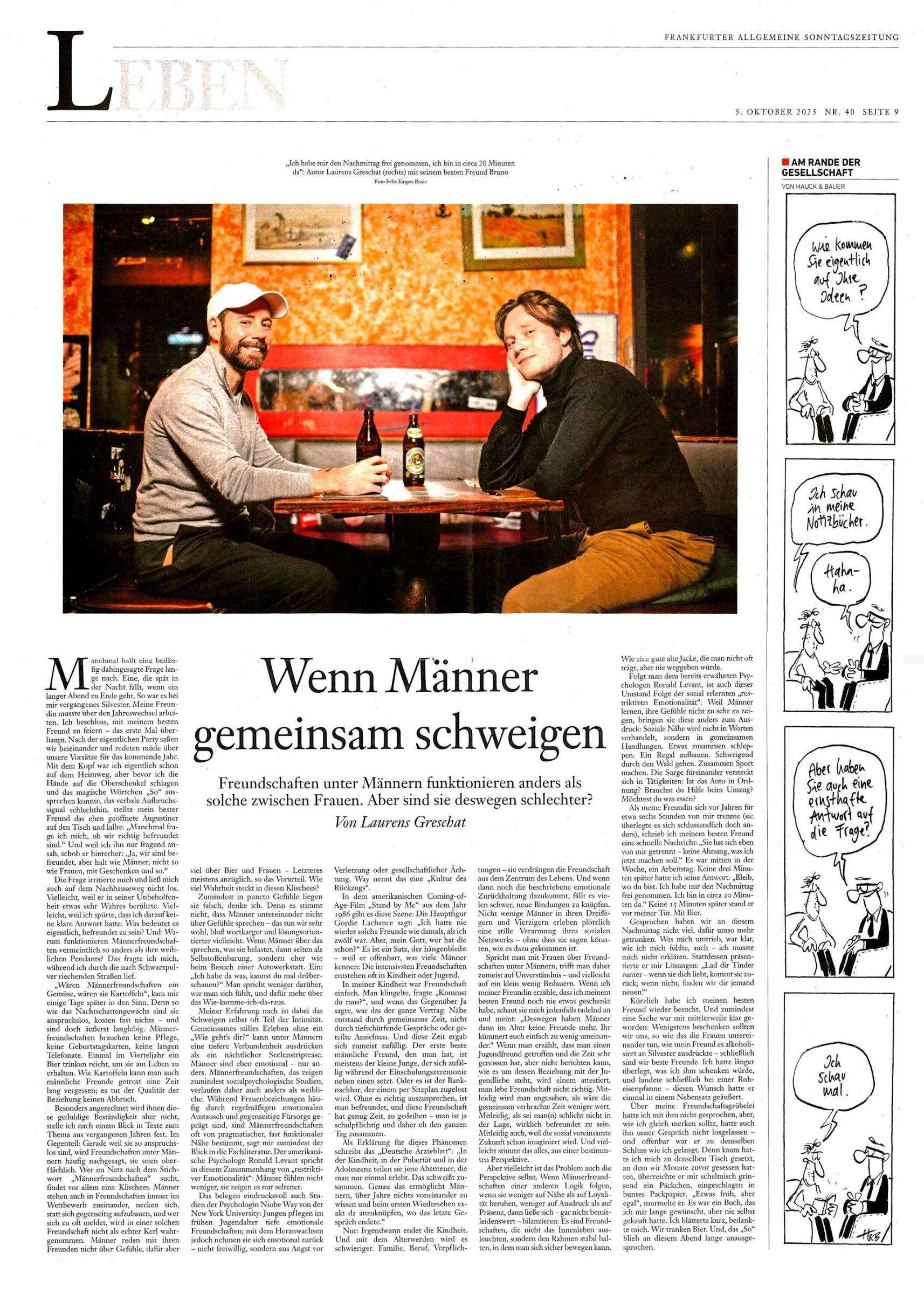
This article "Wenn Männer gemeinsam schweigen" (Why Men have so Few Friends) appeared in the Sunday edition of the Frankfurter Allgemeine newspaper on October 5th. The author reports that he and his best friend met to talk about friendship, and appear in the photo sipping their beers. They even recorded some of their conversation to use in the article. As I read it, I wondered if all Germans are so deathlessly analytical.
At one point, the author asked rhetorically, "What does it mean to actually befriend someone?" He admits that male friendships differ from female relationships, although he denies that men typically do not talk about their feelings. Perhaps their wives, jealous for their husbands' available time, make sure their husbands talk mostly to them. They start their marriages with a kind of house-cleaning, sweeping out most of their husbands' old friends.
Maybe women do socialize more easily than men, but, as a man myself, I suspect that males crave most a sense of direction, a clarification of their goals, and use friendships to help them sort out the intangible necessities. Male social structure is hierarchical. We follow the alpha-males who give us identity, ego-strength, and a sense of belonging—at least until the betas marry and their wives take over.
The author makes the silly comment that, "If male society were a vegatable, it would be the potato." Potatoes are awkwardly round and dirty-looking, pockmarked, and colored an unhealthy greyish-brown.
Let the author speak for himself. I doubt many men want to see themselves as potatoes of any color or shape.
The term "rite of passage" applies mostly to males. We need the structure of a peer-group to move us forward. You either belong and follow, or you're out. Perhaps more than female social groups or potatoes, male social groups resemble a wolf-pack. At a fairly young age, say 13 or 14, the call of the wild awakens in a boy. The force of hormonal change turns him into a lone-wolf and drives him into the wilderness.
It is critical for him to find the appropriate peer-group to move him forward, before the wrong crew gets him, touches that lone-wolf wildness, and moves him backward—into a perverse kind of male-bonding, or some other form of extremist behavior conducted in isolation.
I decided to do a little analyzing myself, of the author and his best friend. Chances are that neither of them has many friends. Forward-looking males don't care to subject themselves to the author's level of analysis, especially when he makes comparisons to potatoes. Let overly analytical students, like those from the psychology department, philosophers, and theologians take their conversation-stoppers somewhere else.
When we children were growing up, my father used a reality-check sort of expression, "The Vale of Tears", from Psalm 84 in the Bible. In one Vale of Tears sermon, he asked me how many friends I had. I don't remember my answer, but I was in school then, and I remember I had a fairly sociable childhood. His reality-check stuck with me all these years: "You'll be lucky if you have more than one." Maybe he could said the same about a peer-group, that you should stick with one. More than one will raise some suspicions—about which one you really belong to.